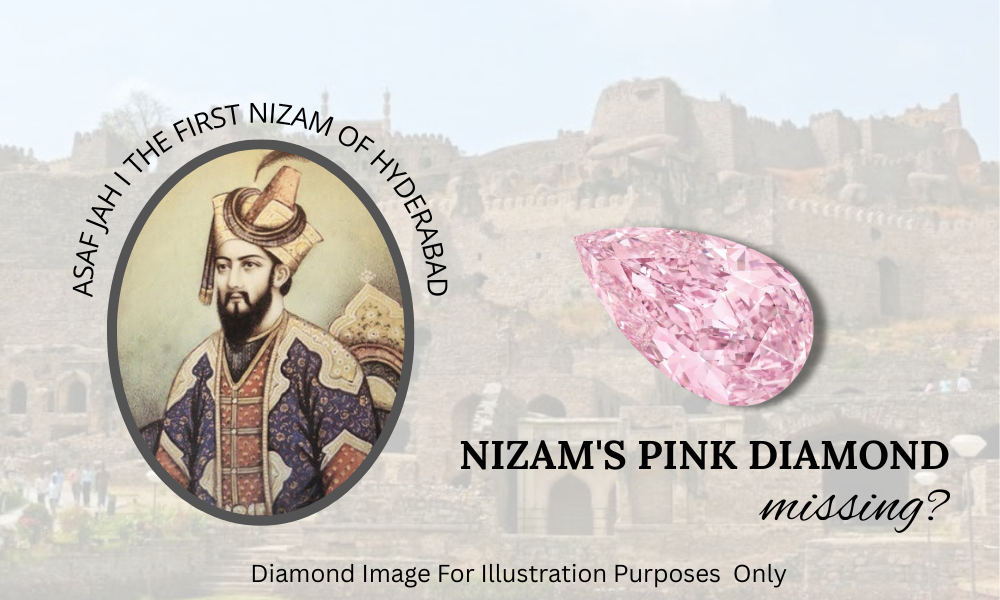

Among the great royal treasuries of the Indian subcontinent, the collection of the Nizams of Hyderabad continues to evoke awe, speculation, and scholarly fascination. Prominent within this legacy is the Seraphim Blue Diamond, a 6 to 8 carat pear-shaped natural blue diamond with an old-mine cut, believed to have once adorned a lavish turban ornament worn by Asaf Jah I, the first Nizam of Hyderabad. Its story, strengthened by repeated mentions across multiple narratives from different sources, has steadily gained interest over time.
Interestingly, this growing attention has had an unexpected effect: it has revived curiosity about another, far more mysterious jewel attributed to the same ruler — a pink Golconda diamond turban ornament, an artifact for which historical information is scarce, fragmented, and surrounded by uncertainty. It should be explained at the outset that, the theory that pink diamonds were never extracted from the Golconda mines – is flawed.
GOLCONDA PINK DIAMONDS
Golconda did yield pink diamonds, though in extremely small quantities. Blue Golconda diamonds like the Hope Diamond and the Seraphim Blue, are classified as Type IIb and owe their blue color to trace boron impurities. Pink Golconda diamonds are classified as Type IIa. The famed Darya-i-Nur, one of the largest known pink diamonds, is widely believed to be of Golconda origin. The Noor-ul-Ain, also displays a delicate pink hue consistent with Type IIa Golconda material. The Agra Diamond, a historic pink gem with centuries of royal provenance, is believed to have a Golconda origin.
The color in pink Golconda diamonds, is not caused by foreign elements but results from subtle lattice distortions created during the diamond’s geological formation. These distortions cause light to interact differently within the crystal structure, giving rise to the delicate pink hue. Even so, only a minute fraction of all Golconda diamonds displayed this rare color, contributing to their exceptional rarity and long-standing mystique.
So while the story of an opulent turban ornament with a pink Golconda diamond, could be true – it is only fair to say that, lack of detailed information leaves room for doubt.
NIZAMS AND THE GOLCONDA REGION
To understand why Golconda diamonds inspire such passion, it is essential to recall that the Nizams controlled the Golconda region — the most celebrated source of premium diamonds until the early 18th century. Golconda diamonds, whether blue, white, or pink, were globally revered for their superb clarity, subtle yet powerful color saturation, and innate brilliance. Many legendary diamonds, including the Koh-i-Noor, the Hope Diamond, The Seraphim Blue Diamond and the Regent, were mined from this region.
With this vast access to the world’s finest gems, the Nizams accumulated a treasury unmatched in South Asia. Diamonds, emeralds, rubies, pearls, and exquisitely crafted ornaments filled their jewel caskets. However, the passage of time, political transitions, custodial changes, and the sheer scope of the treasury contributed to a perplexing loss of documentation. Many treasures of the Nizams were lost, stolen, transferred, gifted, sold, or dispersed without formal records. This lack of cataloging left future historians and gemstone experts with large gaps in understanding what exactly existed and what vanished from the royal inventories.
THE SERAPHIM BLUE DIAMOND
Compared to many of Hyderabad’s lost gems, the Seraphim Blue Diamond has a more consistent narrative. Sources repeatedly describe it as a pear-shaped, old-mine-cut blue diamond, weighing between 6 and 8 carats. The diamond’s provenance is often linked to Asaf Jah I’s personal turban ornament, echoing a tradition among Indian royals of wearing high-value diamonds in ceremonial headpieces.
The coherence of this narrative has helped the Seraphim Blue Diamond gain recognition among traders and collectors. Although not every detail is fully verified, the consistency across reports gives it a level of legitimacy that many Golconda-origin gems lack. This unfortunately cannot be said of the second turban ornament, the one with the pink diamond – also claimed to have been owned by Asaf Jah I the first Nizam of Hyderabad.
THE ELUSIVE PINK DIAMOND TURBAN ORNAMENT
Mentions of another turban ornament worn by the same ruler — this one centered around a pink Golconda diamond — are sparse, vague, and sometimes contradictory. The mere idea of a pink Golconda diamond linked to the Nizam of Hyderabad naturally generates enthusiasm. Pink Golconda diamonds are among the rarest and most desirable gems in the world, coveted for their pure, soft yet vibrant coloration and extraordinary transparency. Their historical examples are few, and virtually all command extraordinary value.
However, the excitement surrounding this pink diamond ornament quickly fades when one looks for concrete information. Reports about the piece rarely offer consistent detail. Basic questions related to shape, cut and current location remain unanswered. The few references that do exist tend to be brief and derived from secondary or tertiary accounts.
Some versions suggest the diamond might have served as a central element in a jeweled turban ornament worn by the first Nizam of Hyderabad, similar in concept to the ornament holding the Seraphim Blue Diamond. Others hint that it might have been part of a larger ceremonial sword. Interesting narratives but low on consistency and details.
SUMMARY
While Golconda diamonds, especially those associated with royal ownership, continue to command significant attention and impressive prices, there is truly no substitute for detailed, consistent, and reliable information about their origins and history. Accurate documentation of such legendary diamonds is often incomplete or scattered, making verification a slow and meticulous process. In many cases, essential details emerge gradually as archives are studied, private collections surface, or modern scientific analyses become available. It is therefore not unusual for authentic and comprehensive information regarding historically important Golconda diamonds to take many years, or even decades, to be fully established.