
There’s a reason perfumers lose sleep over balance.
You can have the most exquisite raw materials, real Assam oud resin, single-origin beeswax absolute, the kind of ingredients that make your accountant visibly sweat, and still produce something that smells like a mistake. Too much sweetness and you’ve got a candle. Too much wood and you’ve got a sauna. The space between those two failure modes? That’s where honey oud lives. And honestly, it’s one of the more impressive tightrope walks in modern fragrance.
Let me explain why that balance is so hard to achieve and why, when it works, it becomes the kind of scent people stop you in an elevator to ask about.
Oud Is Not a Background Note
And here is the part about niche perfumes no one warns you about before you try your first one: oud is never a sprinkle kind of ingredient. True oud, or agarwood, is bold, anima, and slightly medicinal. This oil, obtained from the heartwood of Aquilaria tree, develops its deep and resiny nature due to the presence of a certain mold affecting the tree.
That origin story matters because it tells you something about Oud’s character. It’s not gentle. It doesn’t play nice with lighter notes. It demands to be the loudest voice in the room.
So when a perfumer decides to pair oud with honey, they’re not just making a creative choice; they’re setting up a negotiation.
Why Honey Works Here
I’ve smelled honey oud done wrong. Sugary to the point of cloying, the oud was buried under something that smelled more like a lollipop than a resin. That happens when a perfumer reaches for synthetic honey accords, the kind that lean heavily on ethyl maltol and ionones, all sugar and no depth.
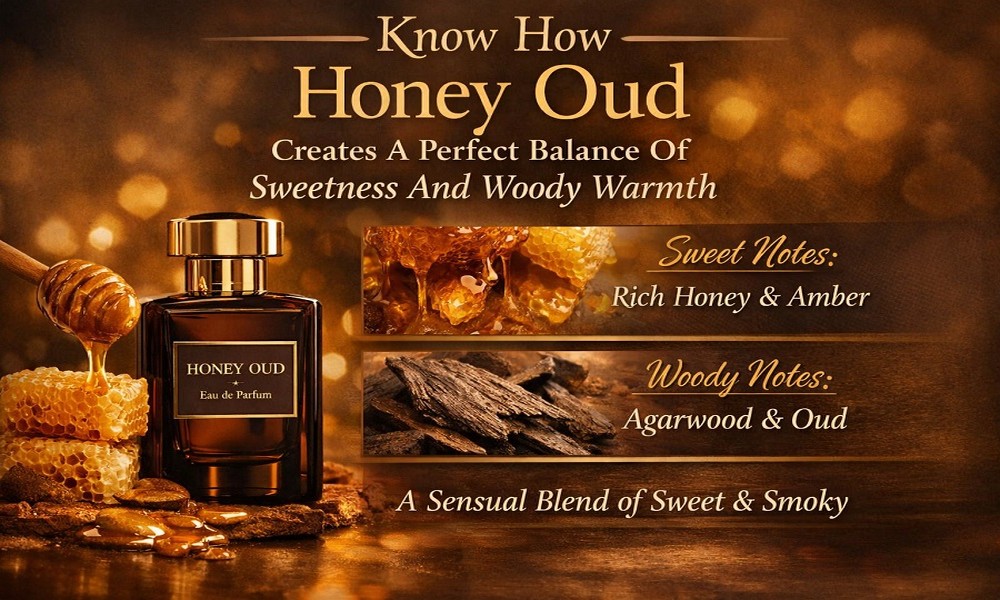
Real beeswax absolute is a different animal entirely. It carries a waxy, pollen-dusted quality, warm, yes, but with a slight graininess that reads as natural rather than manufactured. When that note is introduced alongside oud, something interesting happens. The honey doesn’t sweeten the oud so much as it softens the edges of it. The oud’s medicinal bite recedes. Its barnyard undertones round out. What’s left is the warmth of that deep, resinous, sandalwood-adjacent drydown that oud fanatics chase like a religion.
That’s the trick Honey Oud pulls off. The sweetness isn’t a coating. It’s a translator.
What the Woody Base Notes Actually Do
And here’s where we turn to structural engineering.
The perfume that only had honey and oud in its structure would definitely be lovely, but also not stable, too intense, and not universal enough, lacking that foundation that ensures the longevity of wearability of the scent. Base notes such as sandalwood, vetiver, and cedar are responsible for making sure of it. But sandalwood, in particular. This creamy, milky, soft note acts as a sort of third mediator in this diplomatic process.
Good honey ouds are characterized by woody base notes, which do more than add depth to the fragrance; they also serve to manage longevity, so that you are not left wearing only skin once the intense richness of the initial top notes dissipates. The process of this change in scent, starting from the first warming exhale of the scent spray and moving on to the wood smoke and beeswax after four hours, makes for a good honey oud.
Why It Wears Like a Unisex Scent Naturally
One thing that genuinely fascinates me about honey oud as a fragrance category is how naturally unisex it is. This isn’t a marketing exercise in slapping “for all” on a label. The combination of sweet and woody, of softness and depth, occupies a sensory space that doesn’t culturally code as masculine or feminine. It just smells human.
That universality is partly cultural oud has deep roots in Middle Eastern perfumery, where gender-specific fragrance norms never took hold the way they did in Western markets. And it’s partly chemical. The beeswax and oud molecules interact in a way that doesn’t trigger the learned associations we have with “powdery feminine” or “sharp masculine.” It bypasses those shortcuts entirely.
What to Look For in a Bottle
If you’re approaching honey oud for the first time, skip the department store samplers. Most of what you’ll find there is an approximation of synthetic oud doing a bad impression layered over a generic amber accord. It smells fine. It’s not the thing.
What you want is a drydown that actually changes on your skin. A great honey oud should smell different thirty minutes in than it did at first spray. The top should carry a slight sharpness that’s the oud announcing itself. The middle is where the honey mediates. And by the time it’s been on your wrist for two hours, you should smell something quiet, warm, and impossible to place without knowing what you’re looking for.
That evolution is the whole point. It’s what makes honey oud worth wearing rather than just worth smelling through glass.